* All product/brand names, logos, and trademarks are property of their respective owners.
Sindh’s story reaches far beyond written records. One of its strongest historical foundations is the Indus Valley Civilization, where cities like Mohenjo-daro showed remarkable planning, craftsmanship, trade, and social organization.
Mohenjo-daro is not just an archaeological site. It is a reminder that Sindh was home to one of the world’s earliest urban cultures. Its streets, drainage systems, houses, seals, pottery, and public spaces show how advanced life was in this region thousands of years ago.
This ancient past gives Sindh a deep cultural identity. The land has seen changing rulers, languages, beliefs, and traditions, but its connection to civilization, settlement, and creativity has remained strong. That is why Sindh’s heritage feels layered. Every period added something new, yet the older story never fully disappeared.
Sindh’s story reaches far beyond written records. One of its strongest historical foundations is the Indus Valley Civilization, where cities like Mohenjo-daro showed remarkable planning, craftsmanship, trade, and social organization.
Mohenjo-daro is not just an archaeological site. It is a reminder that Sindh was home to one of the world’s earliest urban cultures. Its streets, drainage systems, houses, seals, pottery, and public spaces show how advanced life was in this region thousands of years ago.
What makes this history even more meaningful is its connection to daily life. The people of ancient Sindh were builders, farmers, traders, artists, and thinkers. They lived close to the river, used skilled craftsmanship, and created systems that reflected order and community.
This ancient past gives Sindh a deep cultural identity. The land has seen changing rulers, languages, beliefs, and traditions, but its connection to civilization, settlement, and creativity has remained strong. That is why Sindh’s heritage feels layered. Every period added something new, yet the older story never fully disappeared.

The Indus River has always been at the heart of Sindh’s life. It gave the land water, supported farming, shaped settlements, and connected communities. For centuries, people built their homes, fields, markets, and traditions around the river.
The river also influenced how people lived. It shaped food, trade, travel, music, and storytelling. Many Sindhi songs and folk memories carry the feeling of the river because it is more than a source of water. It is a symbol of movement, survival, and belonging.
Even today, the Indus remains deeply connected to Sindh’s identity. To understand Sindh cultural heritage, one must understand the river that helped write its story.

Sindh’s culture is full of symbols that people recognize instantly. These symbols are not just decorative. They carry pride, memory, respect, and belonging.
| Symbol | Cultural Meaning |
|---|---|
| Ajrak | Pride, hospitality, and tradition |
| Sindhi Topi | Identity, respect, and cultural honor |
| Sindhi language | Memory, poetry, and storytelling |
| Sufi music | Peace, devotion, and spiritual expression |
| Mohenjo-daro | Ancient roots and civilization |
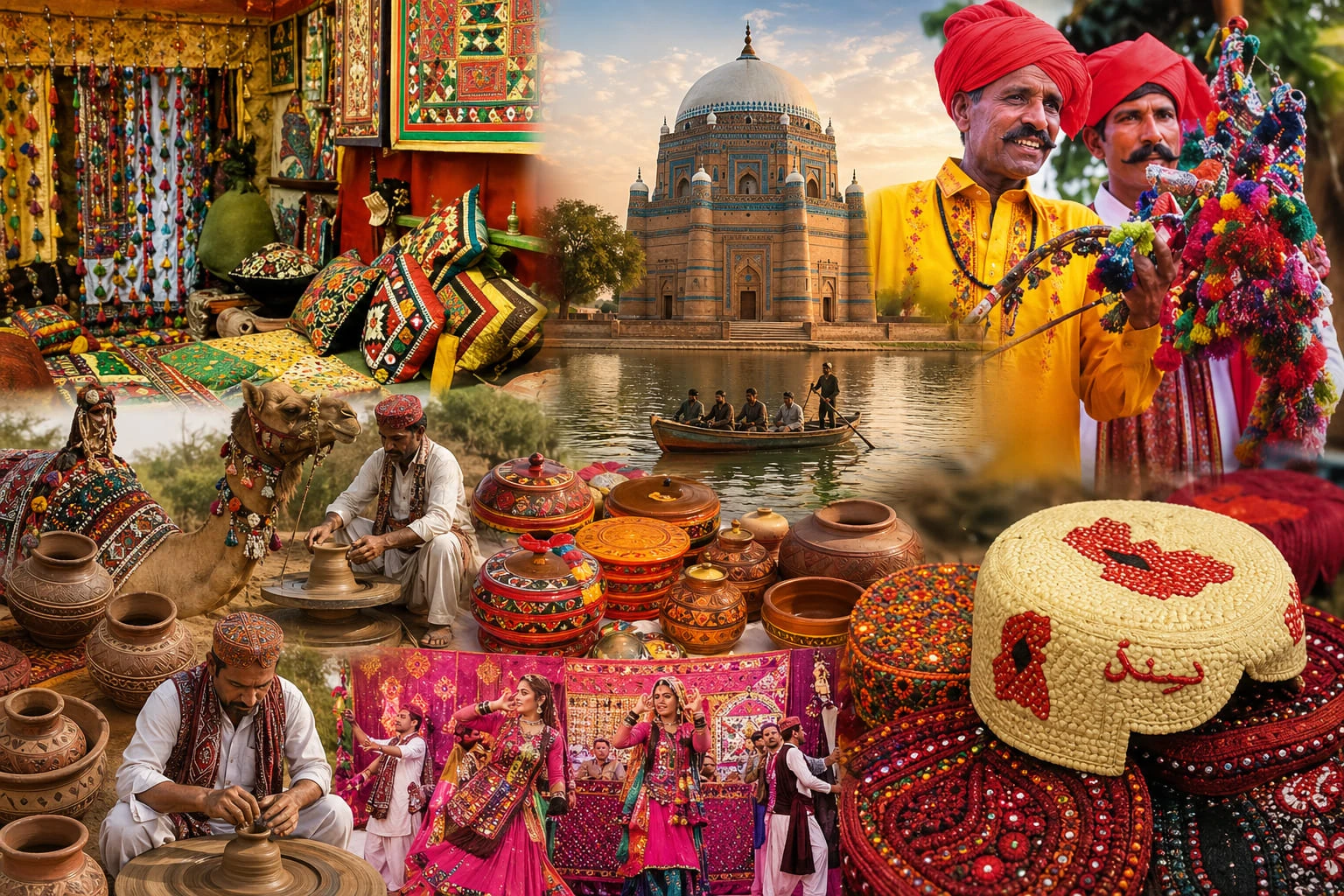
Ajrak and Sindhi Topi are especially powerful because they are worn with pride during cultural events, family gatherings, and celebrations. They show a connection to the land and its people. In the same way, Sindhi language, music, and historical sites keep the spirit of Sindh alive across generations.
Sufism gives Sindh’s cultural heritage its spiritual depth. Across the province, shrines, poetry, music, and gatherings reflect a message of love, peace, tolerance, and unity.
One of the most respected names in Sindhi Sufi tradition is Shah Abdul Latif Bhittai. His poetry speaks about love, longing, faith, courage, and the human journey. Through folk characters and local stories, his verses connect ordinary life with deeper spiritual meaning.
Sufi thought in Sindh has always been close to the people. It speaks in a language they understand and uses stories from the land itself. That is why Sufi poetry feels personal, not distant. It reflects deserts, rivers, villages, travelers, lovers, and seekers.
Sufi music also plays an important role in Sindh. The sound of the sur, devotional singing, and shrine gatherings creates a powerful cultural atmosphere. For many people, these traditions are not only religious practices. They are a way to remember shared values and feel connected to Sindh’s soul.

Language is one of the strongest carriers of Sindh’s identity, and Sindhi has played that role for centuries. It is more than a way to communicate. It holds history, emotions, beliefs, and shared experiences.
Sindhi literature is rich with poetry, folk tales, and oral traditions that have been passed down through generations. These stories often reflect everyday life, love, struggle, nature, and spirituality. They connect people not just to words, but to a deeper cultural memory.
This strong tradition of expression keeps Sindh’s past alive in the present. Even as times change, language and storytelling continue to protect and pass on Sindh cultural heritage in a natural and living way.
Sindh’s artistic heritage can be seen in the things people make, wear, and use in daily life. These crafts are not only beautiful; they carry skills passed from one generation to another.
Sindhi dress also reflects pride and identity. Ajrak, Sindhi Topi, colorful clothes, mirror work, and handmade designs all show how culture remains part of everyday life. These traditions make Sindh’s heritage visible, personal, and deeply meaningful.
Sindh’s culture is also felt through food, celebrations, and the warmth of community life. Hospitality is a strong part of Sindhi tradition. Guests are often welcomed with respect, generosity, and a sense of belonging.
Traditional Sindhi food reflects the land’s tastes and lifestyle. Dishes such as Sindhi biryani, sai bhaji, koki, dal pakwan, and fish from river areas are enjoyed in homes, gatherings, and celebrations. Food is not only about taste; it brings families and communities together.
Festivals and cultural events also keep Sindh’s identity alive. Sindhi Cultural Day is one of the most visible examples, where people proudly wear Ajrak and Sindhi Topi, listen to music, share greetings, and celebrate their roots.
Through weddings, fairs, music gatherings, shrine visits, and family traditions, Sindh’s heritage continues to live in everyday moments.
Sindh’s cultural heritage has survived for thousands of years, but its future depends on the choices made today. Historical sites, traditional crafts, language, and cultural practices all need care, protection, and awareness.
Preservation should not only happen in museums or official records. It also happens at home, in schools, in local markets, and during cultural celebrations. When a child learns Sindhi poetry, when an artisan teaches Ajrak printing, or when families celebrate Sindhi Cultural Day, heritage continues to breathe.
There are also real challenges. Climate change, floods, and urban expansion are putting pressure on historical places and traditional ways of life. Without proper attention, parts of this heritage could slowly fade.
Preserving Sindh cultural heritage is not only about saving the past. It is about protecting identity, creativity, and a way of life for future generations.
There are also real challenges. Climate change, floods, and urban expansion are putting pressure on historical places and traditional ways of life. Without proper attention, parts of this heritage could slowly fade.
Preserving Sindh cultural heritage is not only about saving the past. It is about protecting identity, creativity, and a way of life for future generations.

Sindh’s cultural heritage is a story written through time, shaped by ancient cities, flowing rivers, spiritual poetry, handmade crafts, rich language, and strong community traditions.
From Mohenjo-daro to modern Sindhi Cultural Day, this heritage continues to live in people’s hearts and daily lives. It is seen in Ajrak, heard in Sufi music, spoken through Sindhi language, and shared through food, festivals, and hospitality.
To protect Sindh cultural heritage is to protect a living identity. It reminds us where we come from, what we value, and how culture can keep connecting generations across time.

No bio available yet.
There are some places in Pakistan that do not feel like tourist spots at all. They feel like pauses
16 April 2026
Be the first to share your thoughts
No comments yet. Be the first to comment!
Share your thoughts and join the discussion below.